Building a File Server with Netty - Download Feature
1. Introduction
When using web crawlers to collect data, there's often too much content like images and videos to download completely. So why not just set up a file server directly on the server?
2. Steps
2.1 Create Maven Project
For simplicity, we'll create a new SpringBoot project directly. The setup process won't be covered here.
2.2 Add Dependencies and JAR Plugin
Netty dependency:
<dependency>
    <groupId>io.netty</groupId>
    <artifactId>netty-all</artifactId>
    <version>4.1.50.Final</version>
</dependency>
Since we need to deploy to a server, add the Maven JAR plugin:
<plugins>
    <plugin>
        <groupId>org.springframework.boot</groupId>
        <artifactId>spring-boot-maven-plugin</artifactId>
    </plugin>
</plugins>
2.3 Write Server Code
2.3.1 HttpStaticFileServer Startup Class
HttpStaticFileServer
import io.netty.bootstrap.ServerBootstrap;
import io.netty.channel.Channel;
import io.netty.channel.EventLoopGroup;
import io.netty.channel.nio.NioEventLoopGroup;
import io.netty.channel.socket.nio.NioServerSocketChannel;
import io.netty.handler.logging.LogLevel;
import io.netty.handler.logging.LoggingHandler;

public final class  HttpStaticFileServer {

    static final int PORT = Integer.parseInt(System.getProperty("port", "8081"));

    public static void main(String[] args) throws Exception {
        EventLoopGroup bossGroup = new NioEventLoopGroup(1);
        EventLoopGroup workerGroup = new NioEventLoopGroup();
        try {
            ServerBootstrap b = new ServerBootstrap();
            b.group(bossGroup, workerGroup)
                    .channel(NioServerSocketChannel.class)
                    .handler(new LoggingHandler(LogLevel.INFO))
                    .childHandler(new HttpStaticFileServerInitializer());

            Channel ch = b.bind(PORT).sync().channel();

            System.err.println(" Open your browser and navigate to http://127.0.0.1:" + PORT + '/');

            ch.closeFuture().sync();
        } finally {
            bossGroup.shutdownGracefully();
            workerGroup.shutdownGracefully();
        }
    }
}
2.3.2 Write ChannelInitializer
HttpStaticFileServerInitializer
import io.netty.channel.ChannelInitializer;
import io.netty.channel.ChannelPipeline;
import io.netty.channel.socket.SocketChannel;
import io.netty.handler.codec.http.HttpObjectAggregator;
import io.netty.handler.codec.http.HttpServerCodec;
import io.netty.handler.stream.ChunkedWriteHandler;

public class HttpStaticFileServerInitializer extends ChannelInitializer<SocketChannel> {


    @Override
    public void initChannel(SocketChannel ch) {
        ChannelPipeline pipeline = ch.pipeline();
        // HTTP codec
        pipeline.addLast(new HttpServerCodec());
        // HttpObjectAggregator is useful when you don't want to handle HTTP messages with "chunked" transfer encoding
        pipeline.addLast(new HttpObjectAggregator(65536));
        // Asynchronously write large data streams without consuming large memory or causing OutOfMemoryError
        pipeline.addLast(new ChunkedWriteHandler());
        // Custom channel handler
        pipeline.addLast(new HttpStaticFileServerHandler());
    }
}
2.3.3 Write Custom ChannelInboundHandler
import io.netty.buffer.ByteBuf;
import io.netty.buffer.Unpooled;
import io.netty.channel.*;
import io.netty.handler.codec.http.*;
import io.netty.handler.ssl.SslHandler;
import io.netty.handler.stream.ChunkedFile;
import io.netty.util.CharsetUtil;
import io.netty.util.internal.SystemPropertyUtil;

import javax.activation.MimetypesFileTypeMap;
import java.io.File;
import java.io.FileNotFoundException;
import java.io.RandomAccessFile;
import java.io.UnsupportedEncodingException;
import java.net.URLDecoder;
import java.text.SimpleDateFormat;
import java.util.*;
import java.util.regex.Pattern;

import static io.netty.handler.codec.http.HttpMethod.GET;
import static io.netty.handler.codec.http.HttpResponseStatus.*;
import static io.netty.handler.codec.http.HttpVersion.HTTP_1_0;
import static io.netty.handler.codec.http.HttpVersion.HTTP_1_1;

/**
 * Custom channelInboundHandler that processes FullHttpRequest objects
 *
 *
 */
public class HttpStaticFileServerHandler extends SimpleChannelInboundHandler<FullHttpRequest> {

    public static final String HTTP_DATE_FORMAT = "EEE, dd MMM yyyy HH:mm:ss zzz";
    public static final String HTTP_DATE_GMT_TIMEZONE = "GMT";
    public static final int HTTP_CACHE_SECONDS = 60;

    private FullHttpRequest request;

    @Override
    public void channelRead0(ChannelHandlerContext ctx, FullHttpRequest request) throws Exception {
        this.request = request;
        if (!request.decoderResult().isSuccess()) {
            sendError(ctx, BAD_REQUEST);
            return;
        }

        if (!GET.equals(request.method())) {
            this.sendError(ctx, METHOD_NOT_ALLOWED);
            return;
        }

        final boolean keepAlive = HttpUtil.isKeepAlive(request);
        final String uri = request.uri();
        // Specify the file sharing directory
        final String path = "/root/pythonWorkspace/"+URLDecoder.decode(request.uri());
        if (path == null) {
            this.sendError(ctx, FORBIDDEN);
            return;
        }

        File file = new File(path);
        if (file.isHidden() || !file.exists()) {
            this.sendError(ctx, NOT_FOUND);
            return;
        }

        if (file.isDirectory()) {
            if (uri.endsWith("/")) {
                this.sendListing(ctx, file, uri);
            } else {
                this.sendRedirect(ctx, uri + '/');
            }
            return;
        }

        if (!file.isFile()) {
            sendError(ctx, FORBIDDEN);
            return;
        }

        // Cache validation
        String ifModifiedSince = request.headers().get(HttpHeaderNames.IF_MODIFIED_SINCE);
        if (ifModifiedSince != null && !ifModifiedSince.isEmpty()) {
            SimpleDateFormat dateFormatter = new SimpleDateFormat(HTTP_DATE_FORMAT, Locale.US);
            Date ifModifiedSinceDate = dateFormatter.parse(ifModifiedSince);

            // Only compare seconds since the datetime format we send to client doesn't have milliseconds
            long ifModifiedSinceDateSeconds = ifModifiedSinceDate.getTime() / 1000;
            long fileLastModifiedSeconds = file.lastModified() / 1000;
            if (ifModifiedSinceDateSeconds == fileLastModifiedSeconds) {
                this.sendNotModified(ctx);
                return;
            }
        }

        RandomAccessFile raf;
        try {
            raf = new RandomAccessFile(file, "r");
        } catch (FileNotFoundException ignore) {
            sendError(ctx, NOT_FOUND);
            return;
        }
        long fileLength = raf.length();

        HttpResponse response = new DefaultHttpResponse(HTTP_1_1, OK);
        HttpUtil.setContentLength(response, fileLength);
        setContentTypeHeader(response, file);
        setDateAndCacheHeaders(response, file);

        if (!keepAlive) {
            response.headers().set(HttpHeaderNames.CONNECTION, HttpHeaderValues.CLOSE);
        } else if (request.protocolVersion().equals(HTTP_1_0)) {
            response.headers().set(HttpHeaderNames.CONNECTION, HttpHeaderValues.KEEP_ALIVE);
        }

        // Write the initial line and headers
        ctx.write(response);

        // Content
        ChannelFuture sendFileFuture;
        ChannelFuture lastContentFuture;
        if (ctx.pipeline().get(SslHandler.class) == null) {
            sendFileFuture =
                    ctx.write(new DefaultFileRegion(raf.getChannel(), 0, fileLength), ctx.newProgressivePromise());
            // Write the end marker
            lastContentFuture = ctx.writeAndFlush(LastHttpContent.EMPTY_LAST_CONTENT);
        } else {
            sendFileFuture =
                    ctx.writeAndFlush(new HttpChunkedInput(new ChunkedFile(raf, 0, fileLength, 8192)),
                            ctx.newProgressivePromise());
            // HttpChunkedInput will write the end marker (LastHttpContent) for us
            lastContentFuture = sendFileFuture;
        }

        sendFileFuture.addListener(new ChannelProgressiveFutureListener() {
            @Override
            public void operationProgressed(ChannelProgressiveFuture future, long progress, long total) {
                if (total < 0) { // total unknown
                    System.err.println(future.channel() + " Transfer progress: " + progress);
                } else {
                    System.err.println(future.channel() + " Transfer progress: " + progress + " / " + total);
                }
            }

            @Override
            public void operationComplete(ChannelProgressiveFuture future) {
                System.err.println(future.channel() + " Transfer complete.");
            }
        });

        // Decide whether to close the connection
        if (!keepAlive) {
            // Close the connection after all content is written
            lastContentFuture.addListener(ChannelFutureListener.CLOSE);
        }
    }

    @Override
    public void exceptionCaught(ChannelHandlerContext ctx, Throwable cause) {
        cause.printStackTrace();
        if (ctx.channel().isActive()) {
            sendError(ctx, INTERNAL_SERVER_ERROR);
        }
    }

    private static final Pattern INSECURE_URI = Pattern.compile(".*[<>&\"].*");

    private static String sanitizeUri(String uri) {
        // Decode the path
        try {
            uri = URLDecoder.decode(uri, "UTF-8");
        } catch (UnsupportedEncodingException e) {
            throw new Error(e);
        }

        if (uri.isEmpty() || uri.charAt(0) != '/') {
            return null;
        }

        // Convert file separators
        uri = uri.replace('/', File.separatorChar);

        // Simple security check
        // For production environment, this security check is definitely not enough
        if (uri.contains(File.separator + '.') ||
                uri.contains('.' + File.separator) ||
                uri.charAt(0) == '.' || uri.charAt(uri.length() - 1) == '.' ||
                INSECURE_URI.matcher(uri).matches()) {
            return null;
        }

        // Convert to absolute path
        return SystemPropertyUtil.get("user.dir") + File.separator + uri;
    }

    private static final Pattern ALLOWED_FILE_NAME = Pattern.compile("[^-\\._]?[^<>&\\\"]*");

    private void sendListing(ChannelHandlerContext ctx, File dir, String dirPath) {
        StringBuilder buf = new StringBuilder()
                .append("<!DOCTYPE html>\r\n")
                .append("<html><head><meta charset='utf-8' /><title>")
                .append("Listing of: ")
                .append(dirPath)
                .append("</title></head><body>\r\n")

                .append("<h3>Listing of: ")
                .append(dirPath)
                .append("</h3>\r\n")

                .append("<ul>")
                .append("<li><a href=\"../\">..</a></li>\r\n");

        File[] files = dir.listFiles();
        if (files != null) {
            for (File f: files) {
                if (f.isHidden() || !f.canRead()) {
                    continue;
                }

                String name = f.getName();
                if (!ALLOWED_FILE_NAME.matcher(name).matches()) {
                    continue;
                }

                buf.append("<li><a href=\"")
                        .append(name)
                        .append("\">")
                        .append(name)
                        .append("</a></li>\r\n");
            }
        }

        buf.append("</ul></body></html>\r\n");

        ByteBuf buffer = ctx.alloc().buffer(buf.length());
        buffer.writeCharSequence(buf.toString(), CharsetUtil.UTF_8);

        FullHttpResponse response = new DefaultFullHttpResponse(HTTP_1_1, OK, buffer);
        response.headers().set(HttpHeaderNames.CONTENT_TYPE, "text/html; charset=UTF-8");

        this.sendAndCleanupConnection(ctx, response);
    }

    private void sendRedirect(ChannelHandlerContext ctx, String newUri) {
        FullHttpResponse response = new DefaultFullHttpResponse(HTTP_1_1, FOUND, Unpooled.EMPTY_BUFFER);
        response.headers().set(HttpHeaderNames.LOCATION, newUri);

        this.sendAndCleanupConnection(ctx, response);
    }

    private void sendError(ChannelHandlerContext ctx, HttpResponseStatus status) {
        FullHttpResponse response = new DefaultFullHttpResponse(
                HTTP_1_1, status, Unpooled.copiedBuffer("Failure: " + status + "\r\n", CharsetUtil.UTF_8));
        response.headers().set(HttpHeaderNames.CONTENT_TYPE, "text/plain; charset=UTF-8");

        this.sendAndCleanupConnection(ctx, response);
    }

    /**
     * Send "304 Not Modified" when file timestamp matches the timestamp sent by browser
     *
     * @param ctx
     *            Context
     */
    private void sendNotModified(ChannelHandlerContext ctx) {
        FullHttpResponse response = new DefaultFullHttpResponse(HTTP_1_1, NOT_MODIFIED, Unpooled.EMPTY_BUFFER);
        setDateHeader(response);

        this.sendAndCleanupConnection(ctx, response);
    }

    /**
     * If Keep-Alive is disabled, append "Connection: close" header to response and close connection after sending
     */
    private void sendAndCleanupConnection(ChannelHandlerContext ctx, FullHttpResponse response) {
        final FullHttpRequest request = this.request;
        final boolean keepAlive = HttpUtil.isKeepAlive(request);
        HttpUtil.setContentLength(response, response.content().readableBytes());
        if (!keepAlive) {
            // We will close the connection immediately after sending the response, so we should also tell the client
            response.headers().set(HttpHeaderNames.CONNECTION, HttpHeaderValues.CLOSE);
        } else if (request.protocolVersion().equals(HTTP_1_0)) {
            response.headers().set(HttpHeaderNames.CONNECTION, HttpHeaderValues.KEEP_ALIVE);
        }

        ChannelFuture flushPromise = ctx.writeAndFlush(response);

        if (!keepAlive) {
            // Close the connection immediately after sending the response
            flushPromise.addListener(ChannelFutureListener.CLOSE);
        }
    }

    /**
     * Sets the Date header for the HTTP response
     *
     * @param response
     *            HTTP response
     */
    private static void setDateHeader(FullHttpResponse response) {
        SimpleDateFormat dateFormatter = new SimpleDateFormat(HTTP_DATE_FORMAT, Locale.US);
        dateFormatter.setTimeZone(TimeZone.getTimeZone(HTTP_DATE_GMT_TIMEZONE));

        Calendar time = new GregorianCalendar();
        response.headers().set(HttpHeaderNames.DATE, dateFormatter.format(time.getTime()));
    }

    /**
     * Sets the date and cache headers for HTTP response
     * @param response
     *            HTTP response
     * @param fileToCache
     *            file to extract content type
     */
    private static void setDateAndCacheHeaders(HttpResponse response, File fileToCache) {
        SimpleDateFormat dateFormatter = new SimpleDateFormat(HTTP_DATE_FORMAT, Locale.US);
        dateFormatter.setTimeZone(TimeZone.getTimeZone(HTTP_DATE_GMT_TIMEZONE));

        // Date header
        Calendar time = new GregorianCalendar();
        response.headers().set(HttpHeaderNames.DATE, dateFormatter.format(time.getTime()));

        // Add cache headers
        time.add(Calendar.SECOND, HTTP_CACHE_SECONDS);
        response.headers().set(HttpHeaderNames.EXPIRES, dateFormatter.format(time.getTime()));
        response.headers().set(HttpHeaderNames.CACHE_CONTROL, "private, max-age=" + HTTP_CACHE_SECONDS);
        response.headers().set(
                HttpHeaderNames.LAST_MODIFIED, dateFormatter.format(new Date(fileToCache.lastModified())));
    }

    /**
     *
     * Sets the content type header for HTTP response
     *
     * @param response
     *            HTTP response
     * @param file
     *            file to extract content type
     */
    private static void setContentTypeHeader(HttpResponse response, File file) {
        MimetypesFileTypeMap mimeTypesMap = new MimetypesFileTypeMap();
        response.headers().set(HttpHeaderNames.CONTENT_TYPE, mimeTypesMap.getContentType(file.getPath()));
    }
}
2.3.4 Replace SpringBoot Startup
import org.springframework.boot.autoconfigure.SpringBootApplication;

@SpringBootApplication
public class FileserverApplication {

    public static void main(String[] args) {
        try {
            HttpStaticFileServer.main(args);
        } catch (Exception e) {
            e.printStackTrace();
        }
    }

}
3. Testing
Change the path in channelInboundHandler to a local path and test:
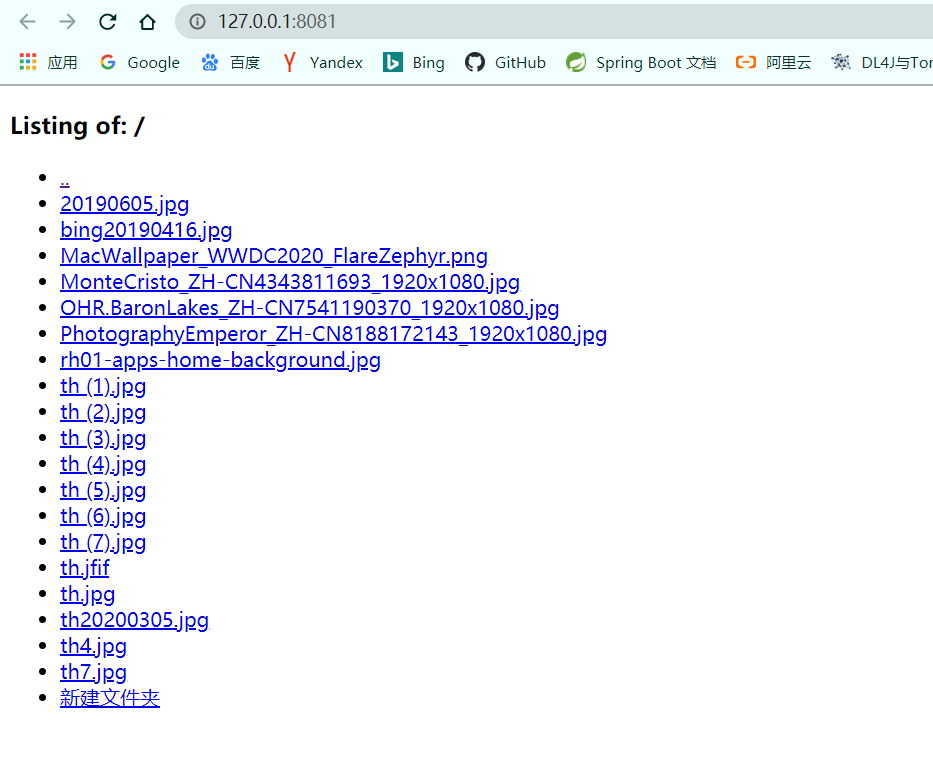
Click to see if you can download:

That's it! A simple file server is complete. Although it can only download files, if you need to deploy it to Linux, just change the path to a Linux path and open the port.